Visitors Counter








|
History: Pakistan Railways started the Karachi Circular Railway in 1969. The aim was to provide better transportation facilities to the people of Karachi. People of Karachi liked it very much and thousands of them traveled daily. KCR earned half a million rupees in the first year alone and revenue continued to increased daily. In seventies when KCR was in peak 104 trains were run daily, of which 80 trains on main track and 24 trains ran on loop line. The transport mafia did not like it and tried to make KCR a failure. The transport mafia contracted the KCR staff and made payments to fail KCR. The staff became lazy and corrupt and trains did not run on time. Ticket less travel became rampant as tickets were not checked. At last KCR trains got discontinued to a minuscule number in 1994 after incurring huge losses. After 1994 only one train ran on loop line and in 1999 KCR operations were completely discontinued. Factors amounting to KCR Failure: 1. Trains did not run according to the Time Table. 2. Tickets were not checked which was the main source of revenue. 3. Bad management and, lazy & corrupt staff. 4. Stations were far from the main roads. 5. No extension of network. 6. Bad condition of locomotives and coaches. 7. No proper arrangement of water and light in Stations. 8. Single Track. 9. Bad law and order situation in Karachi. (Now it is better) 10. Lack of interest by the Government and Pakistan Railways. Current Status: At present, KCR track (Loop line) is in bad condition. Rails and Sleepers have damaged and stealing of rails is still continue. In many places railway track has buried in to the ground. Signaling and Communication system is also out-dated and out of order. KCR stations and land are encroached upon by land mafia and criminals. Due to transport problems and public pressure, Federal Government decided to revive KCR. Plans have been in the offing for the revival KCR since 1999 including a Master Plan made in 2003 but nothing has happened on the ground. Revival: At last a Japanese Government Agency "Japan International Cooperation Agency" has agreed to give a soft loan of 1.5 billion dollars for revival KCR. According to the plan KCR loop line from Karachi City to Drigh Road via Liaquatabad will be revive and a new railway line will be built from Karachi City to Jinnah International Airport along with PR main line. KCR will have dual track and 22.86 km track will be elevated passing through densely populated areas including Baldia, SITE, Nazimabad, Gulshan-e-Iqbal and Gulistan-e-Jauhar. The Circular Railway will carry 700,000 passengers daily through 246 trains, each with a capacity of 1,236 passengers. The track would be of international standard and a train would be available at each terminal after every five minutes. Trains will be run at speeds of 100 km per hour. |
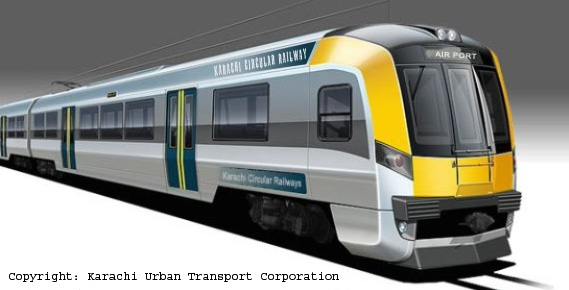
| z | Karachi Mass Transit is the plan of modern
rail based transport system in Karachi. According to
the plan the busy roads of Karachi will have under-ground
and over-head railway corridors and Light Train will be run. Karachi
Circular Railway is
also a part of Karachi
Mass Transit. Government is
considering to build 6 routes on BOT
(Build-Operate-Transfer) basis. Corridor I- Sohrab Goth To Tower: Sohrab Goth to Tin-hatti, 15.2 km on Shahrah-e-Pakistan and M.A Jinnah road via F.B Area, Liaquatabad, Guru Mandir, Jamah Cloth and Boulden Market. Corridor II- Orangi Town to Karachi Cantt: Orangi Town to Karachi Cantt, 13.2 km on Shahrah-e-Orangi, Manghopir Road and Dr Daud Pota Road via Garden and Saddar. Corridor III- North Karachi to S.I.T.E via North Nazimabad: North Karachi to S.I.T.E 15.4 km on Shahrah-e-Noor Jehan via North Nazimabad and Benaras Chowk. Corridor IV- Karachi Cantt to Landhi: Karachi Cantt to Landhi, 20.4 km on Shahrah-e-Faisial parallel to Pakistan Railways Main line via Baloch Colony, Shah-Faisal Colony and Malir Colony. Corridor V- Shah Waliullah Chowrangi to Shah-Faisal Colony: Shah Waliullah Chowrangi (Nagan Chowrangi) to Shah-Faisal Colony, 14.5 km on Rashid Minhas road via Sohrab Goth and Gulshan-e-Iqbal. Corridor VI- Baldia Town to Merewether Tower: Baldia Town to Merewether Tower, 10 km on RCD Highway. |
| KARACHI
the biggest city of Pakistan, is located on
an arm of the Arabian Sea northwest of the Indus
delta. It is a trade and distribution center and
the principal seaport of Pakistan. Karachi was founded
in the 18th Century and was captured by the British in 1843.
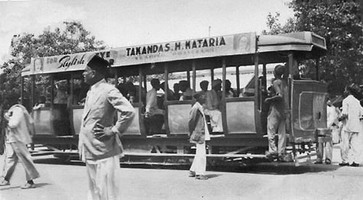
A steam tramway was opened to the port on April 20, 1885,
and was replaced with a horse tramway a year later. In
1909 the horse trams were replaced with distinctive looking
petrol cars. Saddar was the main hub. One route connected
Saddar with the Cantonment Station, the other went all the
way to Keamari, the port, and the third to Soldier Bazaar.
There were 64 of these in service in 1955 when the company
celebrated its 70th Anniversary. The petrol trams continued
in service until April 30, 1975. |